Life in a Dream
Salvador Domingo Felipe Jacinto Dalí i Domènech, Marquess of Dalí of Púbol was born in Spain in 1904 to middle-class parents who encouraged his artistic endeavors. He attended the Municipal Drawing School at Figueres in 1916, and two years later he had his first public exhibition at the Municipal Theatre in Figueres. In 1922, he moved into the Residencia de Estudiantes in Madrid and studied at the Real Academia de Bellas Artes de San Fernando. There he became associated with the avant-garde group Ultra. He was inspired by Futurism, Cubism, and the Dada movement. In 1925 he exhibited 11 works in an exhibition in Madrid where he was praised by critics. He later met and became friends with Pablo Picasso and other Surrealist artists.
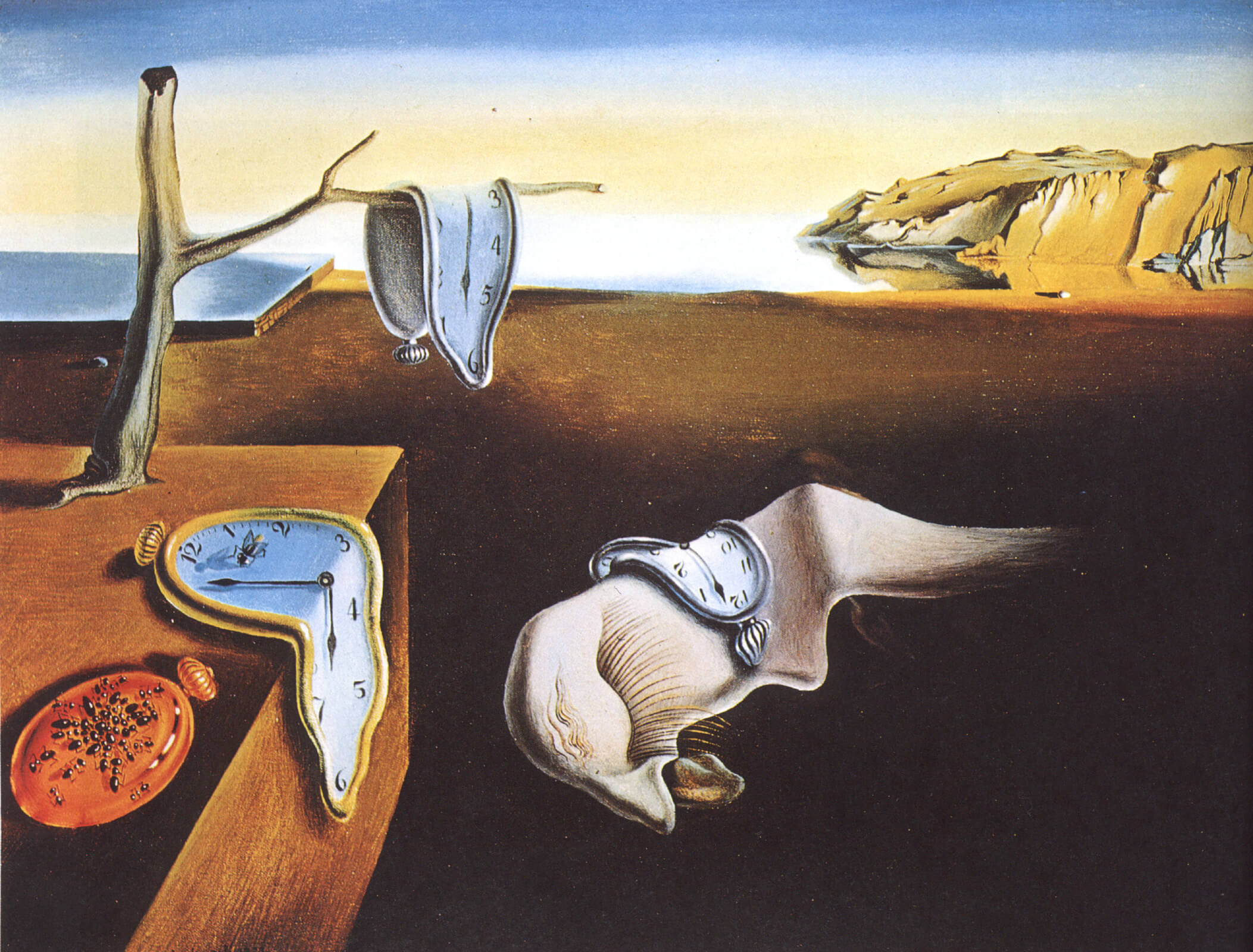
Dalí continued to show his work at exhibitions to critics' praise. From 1927, his work became more influenced by Surrealism, and featured dreamlike images, precise draftsmanship, and idiosyncratic iconography; it sought to explore unconscious desires. In 1929, he collaborated with Surrealist film director Luis Buñuel on the short film Un Chien Andalou. In 1931, he painted one of his most famous works, The Persistence of Memory, which depicted soft, melting pocket watches in a rejection of the assumption that time is rigid or fixed. Dalí had accrued much acclaim and popularity and across the years his works were exhibited in cities such as New York and London. In 1948 he returned to Spain from the United States which prompted outrage from other artists and Surrealists such as Breton and Picasso for supporting Franco's regime. His works during this time were influenced by Catholicism, natural science, mathematics, and optical illusions. His health deteriorated in the 1980s, and in 1989 he died of cardiac arrest at age 84. Dalí is remembered as one of the most influential and controversial artists of the 20th century.